
Open Cumberland County Public Records
Access depends on the record, not just the name attached to it. Deeds, plats, property rolls, marriage records, and much court information are open, though a web index may show less than the official file. Birth and death certificate copies have eligibility rules. Juvenile, adoption, sealed, and protected-address material is not open merely because the same office keeps other government files.
| Cumberland record set | Official keeper | Web route | Access level |
|---|---|---|---|
| Deeds, liens, plats | Register of Deeds | County land index; holdings reach 1754 | Index and instruments open; protected identifiers redacted |
| Civil, criminal, divorce, estates | Clerk of Superior Court | eCourts Portal and Court Dates | Public unless sealed, juvenile, adoption, or otherwise protected |
| Property and tax roll | Tax Administration and GIS | Current card, prior bills, Data Viewer | Free public roll; some tax details excluded |
| Birth and death | Local Registrar, Register of Deeds, NC Vital Records | Order services, not an unrestricted name index | Certified copies limited by recipient rules |
| Marriage | Register of Deeds; NC Vital Records for 1962 forward | County search and order routes | Public record; certification is a separate service |
| Jail and correction | Sheriff and NC Adult Correction | Current inmate and offender lookups | Releaseable custody data, not a full case file |
A search result is often only a finding aid. The source image, paper file, or certified copy carries the legal detail. Driver records are also outside the ordinary open-record trail because federal privacy law protects personal motor-vehicle information. Military discharge records kept by the Register of Deeds have separate limits under state law.
Chapter 132 and Cumberland Records
North Carolina Chapter 132 defines records broadly across paper, email, databases, recordings, and other media made or received in public business. Section 132-6 permits inspection at reasonable times and requires access as promptly as possible. There is no universal fixed number of business days. A large request may take time to locate, review, and redact.
Anyone may request an existing record through an in-person, mail, phone, or electronic channel. Chapter 132 does not impose a state-residency test. An agency need not create a new report, run an analysis that does not exist, or answer a research question. When public and confidential fields can be separated, the custodian should provide a redacted copy rather than withhold the whole record.
Common limits cover criminal investigative material, 911 databases, sensitive personnel details, tax information, trade secrets, security plans, privileged communications, and specified identity numbers. If access is refused, ask for the statute supporting the decision. Section 132-9 permits an enforcement action in superior court and allows attorney fees in defined circumstances.
North Carolina also protects certain addresses and identity fields. The Address Confidentiality Program supplies qualifying participants with a substitute address, while N.C.G.S. §132-1.10 limits disclosure of specified account and Social Security numbers in government records. An exposed identifier should be reported to the custodian, not copied or shared.
Cumberland County Deed Index Access
The Cumberland County Register of Deeds keeps deeds, deeds of trust, mortgages, satisfactions, assignments, easements, restrictions, plats, liens, notary oaths, and marriage licenses. Its land holdings date to county organization in 1754. The current web cutoff is not stated, so an old volume’s existence does not guarantee that every page appears in the live portal.
Grantor means the party giving an interest. Grantee means the party receiving it. Search both roles when following land over time, and try initials or surname variants. A book and page citation gives the most direct route to an older instrument.
| Deed-index field | Input | How it helps |
|---|---|---|
| Grantor / Grantee | Name text | Find parties in either transfer role |
| Begin / End Date | Date pair | Narrow a common or long-used name |
| Book / Page | Numeric pair | Retrieve a known citation |
| Instrument Type | Category | Separate deeds, liens, plats, easements, and other filings |
| Instrument Number | Text or number | Open a known modern filing |
The direct land portal returned an error during research, which makes the office and archived indexes important fallback channels. Call land records at 910-678-7773 or indexing at 910-678-7719. Scanned index books and available document images can also be inspected at the records office.
Five-Minute Cumberland Record Entries
Since January 2015, newly received land instruments can appear in the permanent index within about five minutes. They display in red as “unverified” until indexing and proofing are complete. That speed is useful, but a fresh spelling, party role, or index term should not be treated as final before the entry is checked.
The county’s free Property Notification service watches registered names rather than parcel numbers. A match email includes the name, filing date, book and page, and a link to the land-index image. The official Property Notification description shows the signup route and explains what an alert contains.
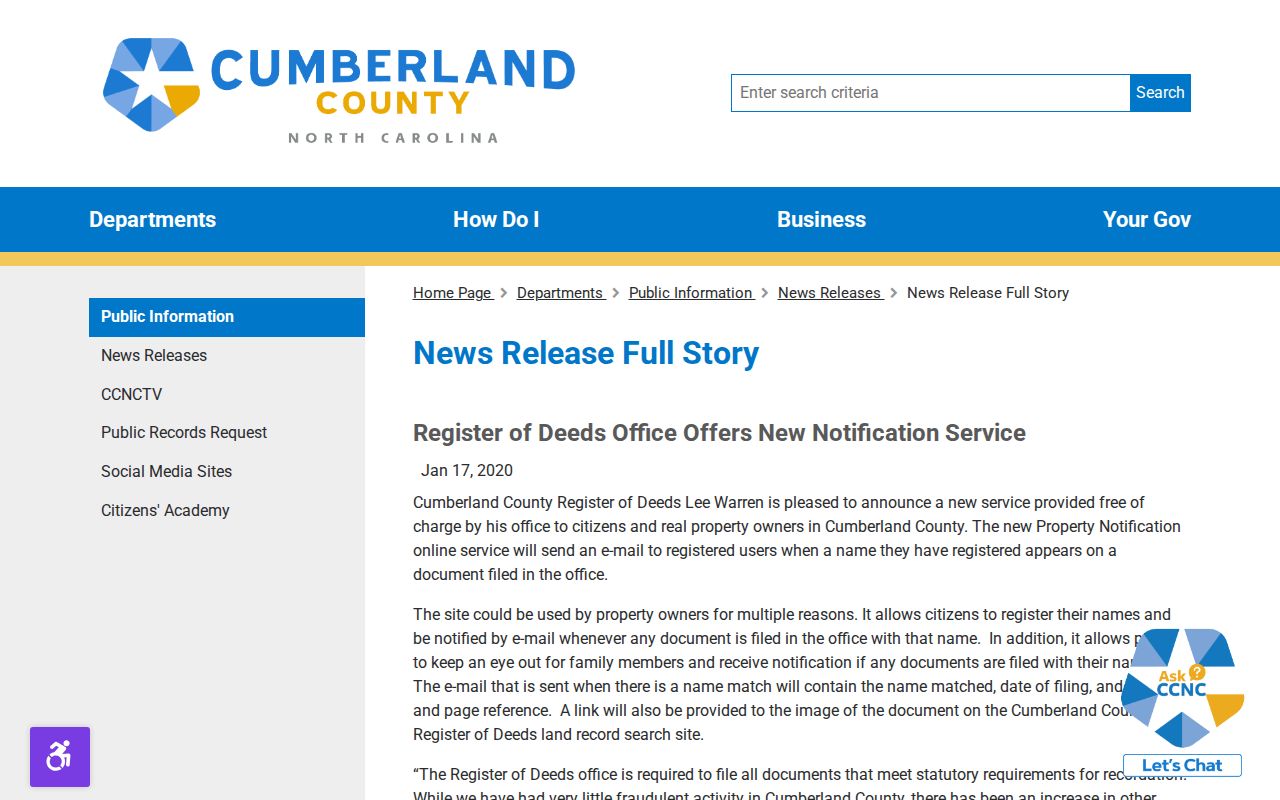
An alert signals a name match. It does not stop a filing or prove fraud. Check the linked image and contact the Register of Deeds before acting on an unexpected notice.
Cumberland County Court Record Channels
Cumberland belongs to Superior Court District 14 and District Court District 14. The Clerk of Superior Court keeps civil, criminal, estate, probate, divorce, guardianship, and special-proceeding files. The statewide eCourts Portal can search by party or business name, case number, and other available criteria. Results may show the case number, parties, type, filing date, events, lawyers, and disposition.
The state’s calendar search is not a full historical file search. It accepts a defendant name or citation, Cumberland as the county, and an optional date filter. When a portal result lacks a document, use a courthouse terminal or request a copy from the Clerk at 910-475-3000. The Judge E. Maurice Braswell Cumberland County Courthouse is at 117 Dick Street in Fayetteville.
Older files may have moved to the State Archives. Juvenile, adoption, sealed, expunged, and protected family matters do not become open through a name query. A booking or charge is not proof of conviction, so the court disposition is the key follow-up record.
Note: Give the Clerk a case number when possible; it is more exact than a name and helps route the request to the right division.
Cumberland County Property Record Limits
Tax Administration Real Estate and GIS provides current property information, prior-year tax-bill routes, and access to the Cumberland Data Viewer. Searches can use owner name, street name, parcel number, or bill number, depending on the system. A card may show the listed taxpayer, mailing address, situs address, parcel identifier, legal description, values, building traits, and a deed citation.
Situs means the physical property location. The mailing address is where the tax bill goes. They can differ, especially for an absentee owner. Tax Administration builds its January 1 ownership roll from indexed legal instruments and estate information, but the county warns that a tax-list name is not a legal opinion of title. Open the cited deed for stronger proof.
Online viewing is free. Older billing detail or a specialized GIS extract may require a direct request. Tax Administration can be reached at 910-678-7507. Property records can help with estate work or ownership research, but they do not by themselves prove where a person now lives.
Read addresses carefully. A taxpayer mailing address can help distinguish owners, but neither that field nor a parcel’s situs proves current residence.
Cumberland County Vital Record Copies
Certified birth and death records are not open browsing products. Under N.C.G.S. §130A-93, certified copies generally go to the person named, a spouse, sibling, direct ancestor or descendant, stepparent or stepchild, an authorized representative, or a person who needs the record to determine legal personal or property rights. Identification and proof of authority may be required.
The Cumberland Health Director serves as Local Registrar, while the Register of Deeds issues county birth, death, and marriage copies. The North Carolina Vital Records portal presents statewide order services and record choices.
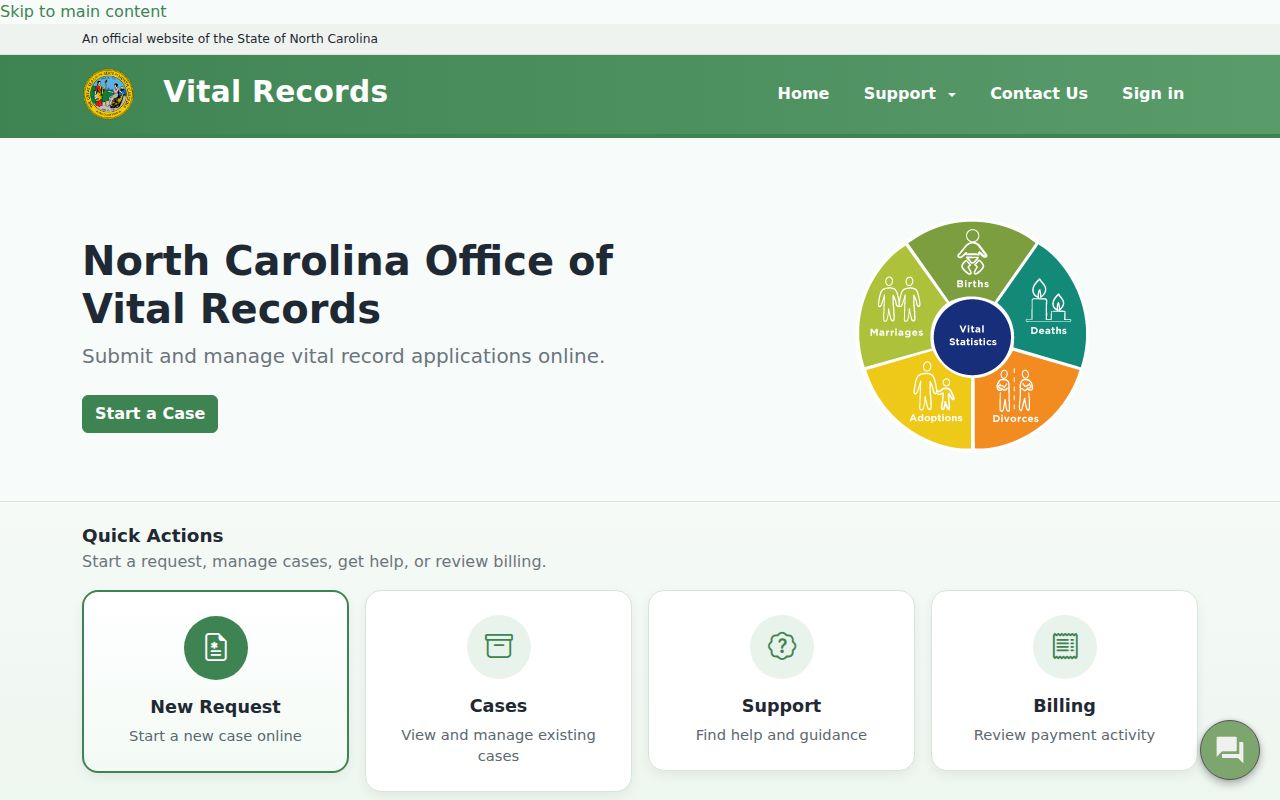
Marriage records are public county records, though a certified copy remains a specific product. State Vital Records manages marriage certificates from 1962 forward; older ones should be requested from the county of issue. Divorce decrees come from the Clerk in the county of filing, not the state vital-record order service.
Cumberland certified birth, death, and marriage copies are generally $10 locally. North Carolina does not use a simple rule that makes all modern certificates open after a set number of years. Historical indexes, archives, church records, cemeteries, and newspapers follow different access paths.
Cumberland County Custodians and Portals
The correct custodian matters. Cumberland County Public Information can route county requests, but it does not control state court files or Fayetteville city records. The deed, court, and tax offices each maintain distinct systems and counter services.
Cumberland Register of Deeds
117 Dick Street, Fayetteville, NC 28301
Land: 910-678-7773
Mail: PO Box 2039, Fayetteville, NC 28302
Clerk of Superior Court
117 Dick Street, Fayetteville, NC 28301
910-475-3000
Court, estate, divorce, and special-proceeding files
Tax Administration
117 Dick Street, Fayetteville, NC 28301
910-678-7507
Property cards, bills, owner roll, and GIS
The Register of Deeds office lists weekday service from 8 a.m. to 5 p.m., with marriage-license service ending at 4 p.m. Phone, mail, online index, and in-person counter channels are available according to record type. Older transferred material may instead require a State Archives catalog search, onsite inspection, or copy order.
Cumberland County Custody Record Access
The Cumberland County Sheriff’s Office provides active-inmate tools for a current custody snapshot. Results may identify the booked person, charges, bond, and custody dates. Incident and accident reports must be requested from the agency that created them. Fayetteville Police and the county Sheriff are separate custodians.
The state Adult Correction Offender Public Information search uses names or an offender number and may show status, location, offenses, and release or supervision dates. It is not a complete criminal-history report. The NC Sex Offender Registry supports name, address, map, radius, and county searches, but only people required by law to register appear there.
N.C.G.S. §132-1.4 opens specified law-enforcement information while protecting criminal investigative and intelligence records. Ask for the public incident fields instead of assuming that narratives, witness statements, footage, or active investigative material must be released. Misusing registry or address data to injure or harass someone is prohibited.
Historic Cumberland Records at State Archives
Cumberland’s oldest land trail crosses two repositories. County holdings run to 1754, while the State Archives catalog identifies deed material beginning in 1752. Archives coverage includes deed indexes through 1942, recorded deeds through 1956, deeds of trust from 1837 through 1956, and mortgage deeds from 1894 through 1947. This is a useful reminder that “the record exists” and “the record is in today’s web portal” are not the same claim.
The State Archives Discover Online Catalog is the starting point for series descriptions, county guides, and request planning.

Many archival descriptions apply to a series rather than an individual person. Search by Cumberland County, record type, surname, and date range, then ask whether the material is digitized, available onsite, or eligible for a copy request. Old court, estate, will, divorce, tax, naturalization, and land series may all supply name evidence.
Note: Cumberland’s northern boundary changed when Harnett County was created in 1855, so older and later records for one place may sit under different counties.
Cumberland County Record Costs
Inspection is generally free under Chapter 132. Section 132-6.2 permits actual-cost copy charges and a reasonable special service charge when a request demands extensive information-technology or clerical work. Ask for electronic delivery and a fee estimate before ordering paper, certification, or a custom data extract.
At the Register of Deeds, uncertified copies are $0.25 per page. Certified instruments generally cost $5 for the first page and $2 for each added page. General instruments cost $26 for the first 15 pages plus $4 per added page; deeds of trust and mortgages cost $64 through 35 pages plus $4 thereafter. Plats cost $21 per page. These filing charges differ from copy charges.
- Index
- A list of record references, names, dates, and document types used to locate the source.
- Image
- A scan of the recorded instrument or page, which may contain detail not shown in the index.
- Certified copy
- An official reproduction carrying the custodian’s certification, usually for a stated fee.
- Custodian
- The office responsible for maintaining and releasing a particular record.
- Exemption
- A statute that protects a record or field from ordinary public release.
Request Cumberland County Public Records
Begin with the office that created or keeps the material. A narrow request for an existing record is easier to fulfill than a broad question. Include the record type, date span, names, address, and any parcel, case, book-page, or instrument number already known.
- Identify the custodian. Send county administrative records to the relevant department, court files to the Clerk, and city records to the proper municipal office.
- Check the official index first. Save exact spellings, dates, and identifiers that will narrow the request.
- Describe an existing record and request inspection or an electronic copy. Give contact details if delivery or follow-up will be needed.
- Ask for a cost estimate before paper certification, special programming, or a large copy run. Use the dedicated application for a restricted vital record.
- If access is denied, request the statutory basis and ask for separable public fields in a redacted copy. Section 132-9 provides the court-enforcement route.
The Cumberland County Public Information request entry point helps route county records requests and explains the local channel.
The request route does not transfer custody from the Clerk, Register of Deeds, Sheriff, or a city agency. Save the submission confirmation and the custodian’s fee estimate. A response must be as prompt as possible, but North Carolina law sets no single deadline for all requests.
Lawful personal use. Open records may support genealogy, estate research, ownership checks, and civic review. Public access never permits stalking, threats, harassment, or harm.