
Start a Cumberland County People Search
Cumberland County has no single government database that joins every person to every public file. Start with the fact already known. A full name works in the deed index, state court tools, voter lookup, business filings, license verifications, and correction records. An address is more useful in the tax roll and GIS viewer. An old Fayetteville address may lead instead to a city directory, yearbook, newspaper, or estate file.
Keep namesakes separate. Record middle initials, suffixes, dates, and the office that supplied each result. A tax listing, voter entry, or court calendar is a dated fact, not proof of a person’s present home or legal status. Two independent records with compatible dates make a far better match.
- Search the county tax and deed routes for a name or known address. Save the parcel number and any deed book and page.
- Check the North Carolina court-date search and eCourts Portal. Treat a calendar hit as a scheduled event, not a final case result.
- Use voter, business, license, or correction searches only when that record type fits the person and purpose.
- For a past resident, move to obituaries, directories, probate files, deeds, and State Archives holdings.
- Contact the actual custodian when an index fails or a complete file is not online.
Cumberland County Records Search Offices
Three offices form the core local trail. The Register of Deeds indexes land instruments, plats, liens, assumed names, notary oaths, marriages, and county vital-copy services. The Clerk of Superior Court holds civil, criminal, estate, divorce, and special-proceeding files. Tax Administration turns recorded instruments and estate information into the annual property roll. Detailed access rules and request methods belong with the Cumberland County public records system.
Cumberland County Register of Deeds
117 Dick Street
Fayetteville, NC 28301
910-678-7775
Clerk of Superior Court
117 Dick Street
Fayetteville, NC 28301
910-475-3000
Cumberland Tax Administration
117 Dick Street
Fayetteville, NC 28301
910-678-7507
Cumberland Property Records Find Owners
An address can become a name through the Cumberland County property routes. Search Tax Administration by owner, street, parcel number, or prior-year bill. A result may show the listed owner, taxpayer mailing address, situs address, parcel identifier, values, improvement facts, and a deed citation. “Situs” means the physical parcel address. The mailing address is where tax notices go, and the two addresses may differ.
The parcel number is the strongest bridge to the GIS map and older bills. A deed book and page can then move the search into the Register of Deeds index. The county warns that its January 1 tax listing is not a legal opinion of ownership, so confirm title in the recorded instrument.
The county’s Real Estate and GIS page shows the available property paths.
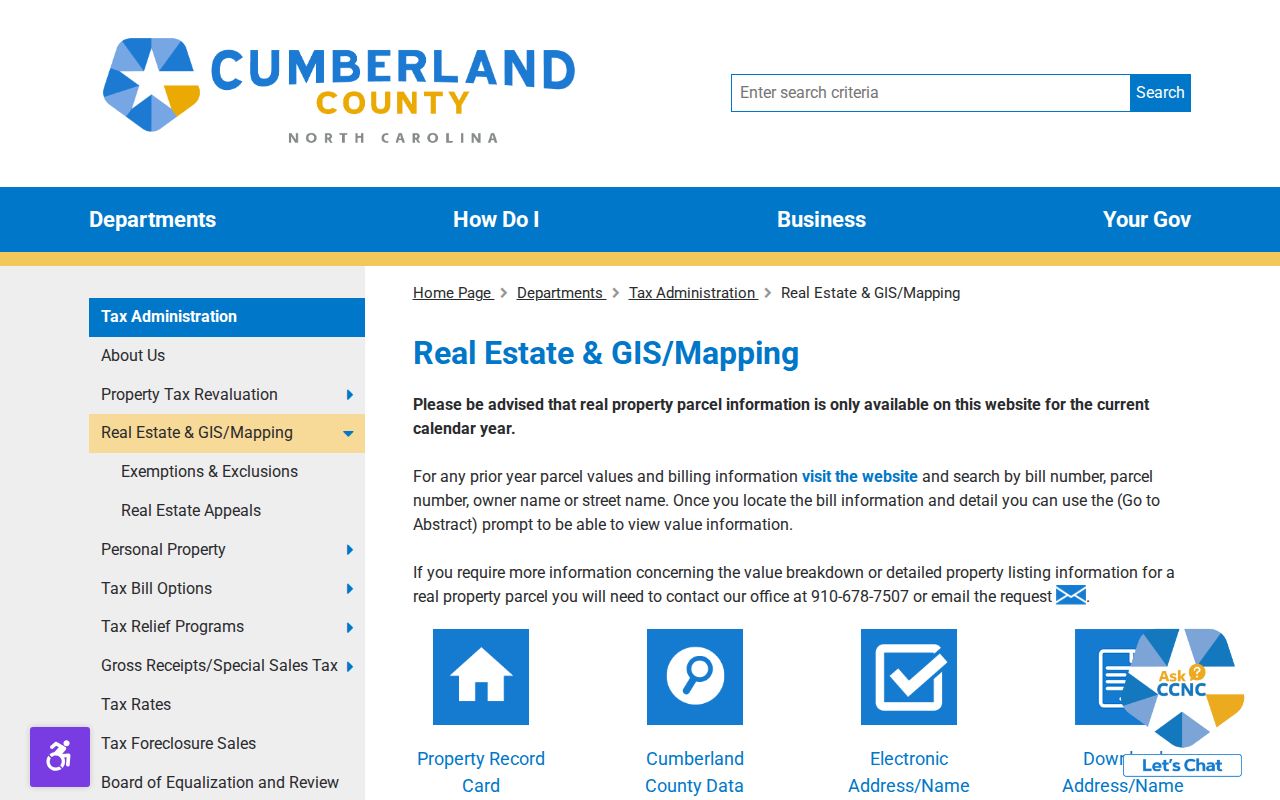
The property page separates current cards, older bills, and map tools, which helps explain why one search box may not answer every address question.
Address tip. A tax mailing address may identify an owner who lives elsewhere, but it does not prove anyone resides at either address.
Cumberland Deed Search Fields
The Register of Deeds name index works best when the role and date range are clear. A grantor gives or conveys an interest; a grantee receives it. Search both roles because the same person may buy, borrow against, and later sell land. County holdings reach to 1754, while State Archives deed indexes begin in 1752. That does not mean each early image appears in the current web interface.
| Search control | Use | Best practice |
|---|---|---|
| Grantor or grantee | Party name | Try initials and both roles |
| Begin and end dates | Time range | Narrow common surnames |
| Book and page | Known citation | Copy from a tax card or deed |
| Instrument type | Record category | Separate deeds, trusts, liens, and plats |
| Instrument number | Modern direct key | Use the full known number |
Newly received land records have been scanned since January 2015. They may appear as red “unverified” entries within about five minutes, before indexing and proofing finish. Recheck a fresh entry after the office completes that work.
- Index
- A finding list that points to a recorded item.
- Instrument
- The deed, lien, plat, or other filed document.
- Book and page
- The citation used to retrieve the recorded image or copy.
- Parcel
- A mapped unit of land with its own county identifier.
Cumberland Court Records Name Lookup
Cumberland County sits in Superior Court District 14 and District Court District 14. The North Carolina Court Dates search accepts a defendant name or citation and a county filter. It finds scheduled appearances, not a full historical case file. The eCourts Portal is the broader public case-information route when Cumberland data and documents are available.
A public docket can show a case number, court, filing date, parties, attorneys, events, and disposition. “Disposition” is the recorded outcome or current resolution of a matter. Juvenile, adoption, sealed, expunged, and protected family details remain closed. When online results stop short, use a courthouse terminal or ask the Clerk’s civil, criminal, estates, or special-proceedings desk for the file.
| Record route | Best for | Limits | Fallback |
|---|---|---|---|
| Court Dates | Upcoming appearances | Not a case history | eCourts or Clerk |
| eCourts Portal | Public case information | Some files and images unavailable | Terminal or copy request |
| Eastern District of North Carolina | Federal cases | PACER normally bills by page | Federal courthouse terminal |
The official Court Dates form shows how names and county filters narrow the calendar.
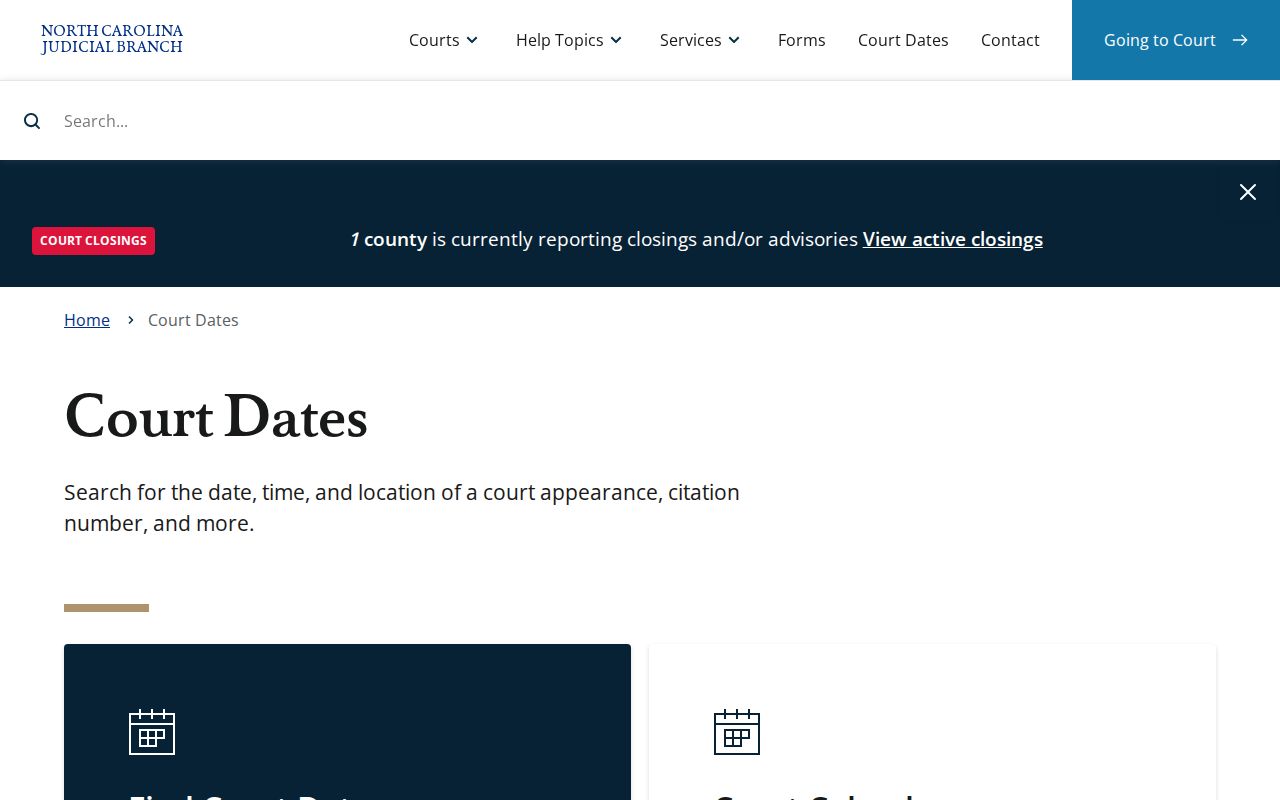
A calendar match should lead to the docket or clerk file before any conclusion is drawn about the case.
Cumberland Vital Records Search Paths
The Cumberland Health Director serves as Local Registrar, the Register of Deeds issues county birth, death, and marriage copies, and North Carolina Vital Records keeps statewide originals. Certified birth and death copies are limited by N.C.G.S. §130A-93 to specified relatives, the person named, an authorized representative, or someone with a qualifying legal need. Marriage records are public county records, but certification is a separate service.
Divorce files take a different path. The Clerk holds the decree and case file; the state vital-statistics product is not a substitute for the pleadings and order. Statewide birth and death registration began in 1913. Earlier family research shifts to county material, churches, cemeteries, newspapers, delayed registrations, and family Bibles rather than assuming a modern certificate will be openly searchable.
North Carolina does not apply a simple rule that every modern vital record becomes fully open after a set number of years. Historical indexes and Archives material have different access paths.
Cumberland Custody Records Need Context
The Cumberland County Sheriff’s active-inmate tools provide a current custody snapshot. The statewide Offender Public Information search can match a name or offender number to correction status, location, and release or supervision dates that are public. Neither source is a complete criminal-history report.
Charges are not convictions. Follow a booking result to the court docket and disposition, and contact the agency that created an incident report when the public portion is needed. North Carolina law releases specified incident facts while protecting criminal investigative and intelligence records.
The state correction search offers a dedicated name and identifier route.
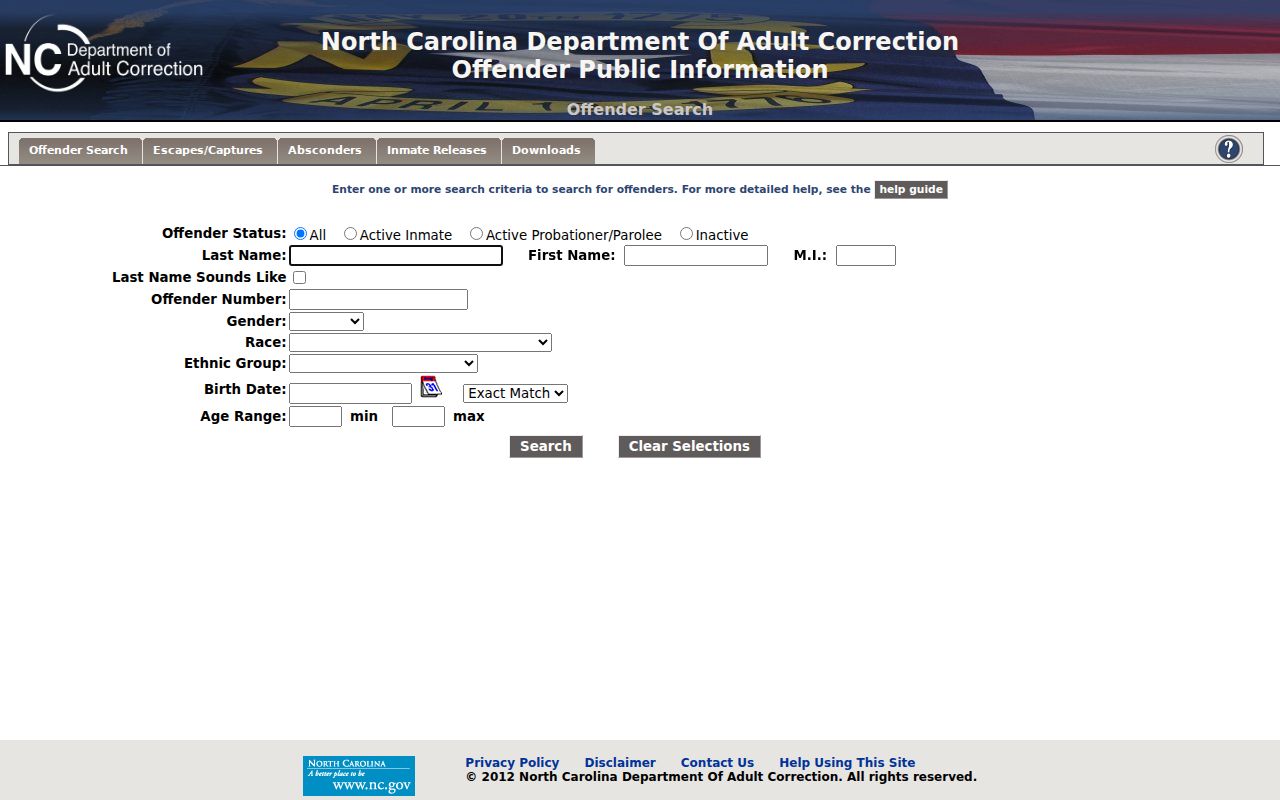
The form’s status and date fields help distinguish a current record from an older Cumberland County name match.
Cumberland Registry Search Boundaries
The North Carolina Sex Offender Registry supports name, address, county, map, and radius searches. A public entry can include identity details, a photograph, registered address, offense information, and registration facts. It covers only people who fall within the registry statute, so absence is not proof of a broader history or status.
Use the official map and address tools for personal safety, then verify the record in its original context. The registry warns against harassment and misuse. Cumberland County records and search tools must never be used to stalk, threaten, or harm another person.
The registry screen makes the difference between name and geographic searches visible.
A map result identifies a statutory registry entry, not every person connected with a Cumberland County address.
Cumberland Probate Records Connect Heirs
An estate file can connect a deceased owner to heirs, a personal representative, creditors, and later property transfers. Begin with the Clerk of Superior Court Estates Division. Search the eCourts Portal where an index is available, then request or inspect the complete local file. Older transferred estates, wills, and court series may require the State Archives catalog and an onsite or copy request.
The most useful chain is often simple: obituary to estate file, estate file to deed, and deed to a later owner. Cemetery or funeral notices may confirm relatives named in probate. For an old address, the county tax card also may point toward an estate because Tax Administration uses Estates Division information for its January 1 listing.
Adoption records are confidential. Birth-family research should use lawful North Carolina reunion, medical-information, Clerk, and health-agency procedures rather than trying to work around sealed files.
Cumberland Search Spans Changing Borders
Cumberland County formed from Bladen County in 1754. Harnett County was created from northern Cumberland in 1855. A family may appear under a new county even when the household did not move. Fayetteville is the county seat, but a Fayetteville mailing address may sit outside city jurisdiction. Hope Mills, Spring Lake, and other towns also keep some of their own files.
This matters most for permits and code records. County Planning and Inspections excludes Fayetteville, Hope Mills, and Spring Lake. A blank county search can mean the address belongs in a municipal system, not that the record does not exist. Confirm the parcel and governing town before contacting a custodian.
Fort Bragg adds another naming issue. Search both Fort Bragg and Fort Liberty in records from the 2023 to 2025 period, and test former states when a military family’s local trail is short.
Note: Repository borders and place names change, so record the jurisdiction and date with every Cumberland County search result.
Cumberland Archives Hold Unusual Names
The deepest Cumberland County people search is hybrid. The Register of Deeds handles present access, while the State Archives preserves deed indexes from 1752 through 1942 and deed series through 1956. Cumberland Miscellaneous Records reach beyond the usual deed and census trail. They include naturalization papers, a cohabitation certificate, delayed-birth material, auctioneer returns, and Bank of Fayetteville records.
Some lists are striking. Archives descriptions identify 1764 to 1765 bounty payments for wildcat scalps and Civil War corn and salt distributions that name needy families. These records can place a person in a community when standard sources are thin. Search the catalog by county and record series, then order a copy or inspect the material in Raleigh when only a series description is online.
For African American family history, the 1866 cohabitation record, estate and deed files, church and cemetery collections, and Fayetteville State sources can bridge periods when surnames were recorded unevenly. Scottish Highland names also need variant searches such as Mc, Mac, spacing changes, and initials.
Cumberland Official and Commercial Search Results
Official indexes answer narrow questions tied to a custodian and date. A deed index shows parties to an instrument. A tax roll shows the listed taxpayer for a parcel. A court calendar shows a scheduled event. Commercial people-finder databases combine public and private feeds, may merge namesakes, and cannot replace a certified copy or complete court file.
| Source type | Strength | Common limit |
|---|---|---|
| Cumberland County index | Named custodian and record date | May omit images or older volumes |
| North Carolina portal | Statewide comparison | Protected fields and sealed matters stay closed |
| Commercial compilation | Broad starting lead | Stale data and merged identities |
Use compiled data only to form a possible lead. Verify names, dates, and addresses with the office that created the underlying record. For lawful personal research, the shortest path is usually the most specific official source.
Cumberland Records Continue Offline
An online no-result is not the end of a Cumberland County search. The courthouse terminal can expose public case information or documents that remote access does not. The Register of Deeds counter and scanned index books reach beyond a simple web result. The public library can help with Fayetteville city directories, reverse directories, telephone books, yearbooks, newspapers, obituary research, and licensed genealogy databases, although exact directory years should be confirmed with staff.
The State Archives Discover Online Catalog is a finding tool, not a promise that each item is digitized. Many Cumberland court, deed, estate, tax, and miscellaneous series still require a copy order or onsite inspection. For city and county agency files, Chapter 132 permits requests in ordinary channels such as email, mail, phone, or in person. Ask for an existing record, name the date range and office, and request an electronic copy when practical.
Library staff are another strong bridge between web access and a record box. Cumberland County Public Library’s Local and State History resources may lead to city and reverse directories, telephone books, newspaper microfilm, yearbooks, and obituary material. A reverse directory lists an address first and then the resident or business associated with it. Pairing one directory year with a deed, census schedule, or obituary can separate an occupant from the parcel owner. Collection years vary, so ask staff to confirm the run before planning a visit.
A request should be precise but need not use special legal words. Give the custodian a record type, department, date span, known name, address, and any parcel, case, or book-page number. North Carolina agencies need not create a new record or answer a research question. They should provide an existing public record as promptly as possible, redact protected fields when they can be separated, and explain the legal basis for withheld material.
That fallback chain keeps the search tied to real custodians: portal, office terminal, counter request, library, then archives. Each step reaches a different layer of Cumberland County’s record trail.